Draw a vitral panel, print it on a translucent base
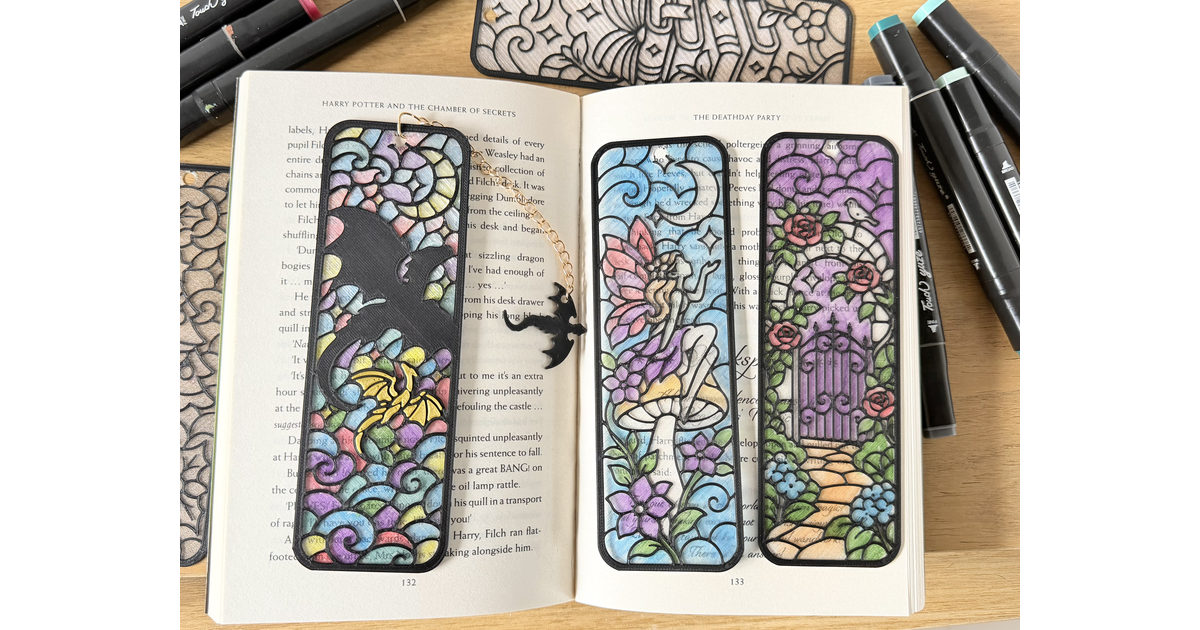
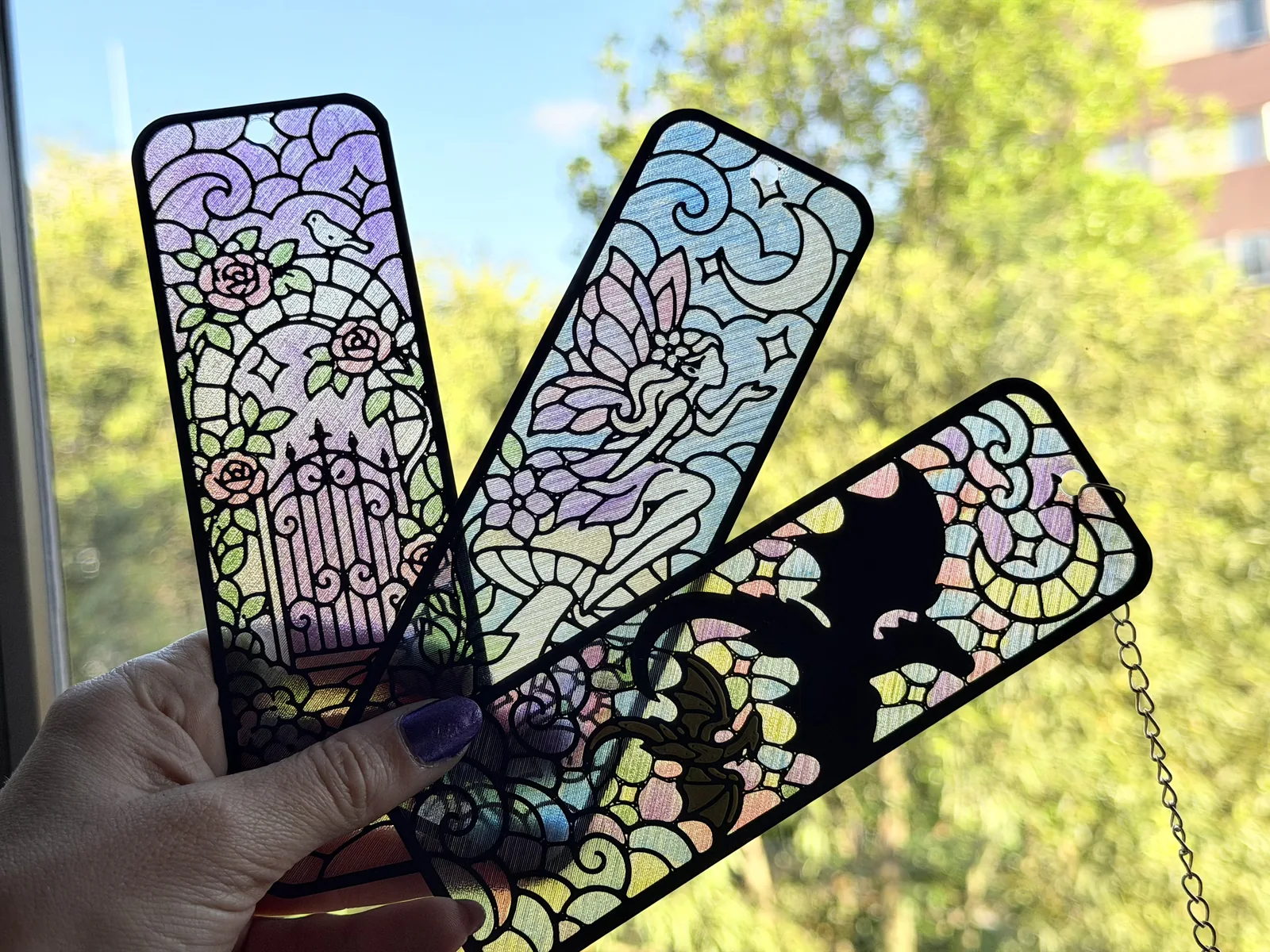
Draw a stained-glass panel and print it as a bookmark. The artwork's own outline is the piece: a translucent base carries the drawing and the opaque line work sits on top of it, so the light coming through the page reads the colours the way a vitral window does.
Translucent base: the body prints in translucent PLA and the artwork is opaque on top of it. The file comes with the slicer settings that make the base read as glass instead of as hatched infill — open it directly, don't import it.
Outline is the piece: the drawing defines the bookmark's shape, with no frame and no backing plate unless you draw one.
Tassel loop or punched hole: placed wherever you want it, printed as part of the body with no seam where it meets the bookmark.
Charm canvas: a second canvas designs a charm to hang from the tassel, with its own hole and its own download file.
Three build modes: face up stacks the colours on the base for multi-material printers, face down carves them into the face, and one colour per layer builds a stack of slabs with a filament swap at every boundary — the same choice drives the preview and the download.
Stained-glass line art is exactly what an image model is good at. Paste this prompt into ChatGPT, replace with whatever you want on the bookmark, then bring the result into the design editor:
Create a tall, vertical bookmark illustration featuring [SUBJECT / THEME], in an elegant ornamental stained-glass coloring-book style. The canvas must have an exact aspect ratio of 1:3 (width:height), approximately 512 × 1536 pixels. The composition must be perfectly vertical and narrow, with a thick, solid black rounded rectangular border following the entire perimeter, with generously rounded corners.
Use pure black-and-white line art, with a completely white background and bold, smooth, consistent black outlines. The illustration should resemble an intricate stained-glass window combined with Art Nouveau ornamental design. Use flowing organic shapes, elegant curves, decorative swirls, and interconnected patterns. The main subject should be large, visually prominent, and positioned as the central focal point. Fill the surrounding space with complementary decorative elements that enhance the theme, distributed throughout the entire bookmark, including the top and bottom areas. Create a cohesive composition where ornamental elements flow naturally into each other and connect to the main subject or surrounding frame. Every shape must have clearly defined, fully enclosed boundaries, like individual stained-glass panels, creating distinct areas that can be colored. All lines must connect to another line, the main illustration, or the outer frame. Avoid floating, disconnected, or unfinished lines. Balance larger open coloring areas with smaller intricate decorative details. Use rounded, clean edges and consistent bold stroke thickness throughout the illustration. Keep the composition symmetrical or visually balanced while allowing the organic elements to flow naturally. No colors, grayscale, gradients, shadows, textures, shading, sketch lines, thin strokes, realistic rendering, or 3D effects. No text or lettering. No large empty spaces. No elements cropped awkwardly by the frame. The final result must look like a polished, intricate, printable stained-glass bookmark coloring page, with bold black outlines, flowing ornamental details, interconnected shapes, and clearly enclosed white coloring areas.
The 1:3 canvas and the fully enclosed shapes are what matter: every closed area becomes a panel you can colour, and the outer border becomes the bookmark's edge.
Size: 53.4 × 162.1 × 1.4 mm
Time to print: 57 min
Filament: 9.85 g
Translucent base:
Print the base in translucent PLA — the artwork is opaque on top of it.
Open the downloaded file directly in the slicer. Do not import the model into a new project and do not add it to an existing plate: the settings below travel with the file and are lost on import.
Settings already in the file:
0.2 mm layer height.
On the translucent base: aligned rectilinear on the top, bottom and internal solid infill, so every layer runs the same way.
Interface shells on and top one-wall off, so the layers under the artwork print as a top surface instead of internal infill.
Walls, infill and top surface slowed to 20 mm/s on the base.
Tags: bookmark, stained-glass, vitral, translucent, custom-design, tassel-charm, multicolor, reading-accessory